Why a 1990s Fraud Detection Case Still Matters in the Age of AI
What a 1995–1997 Insider Dealing Detection Case Still Teaches Us About Data, AI, and Governance
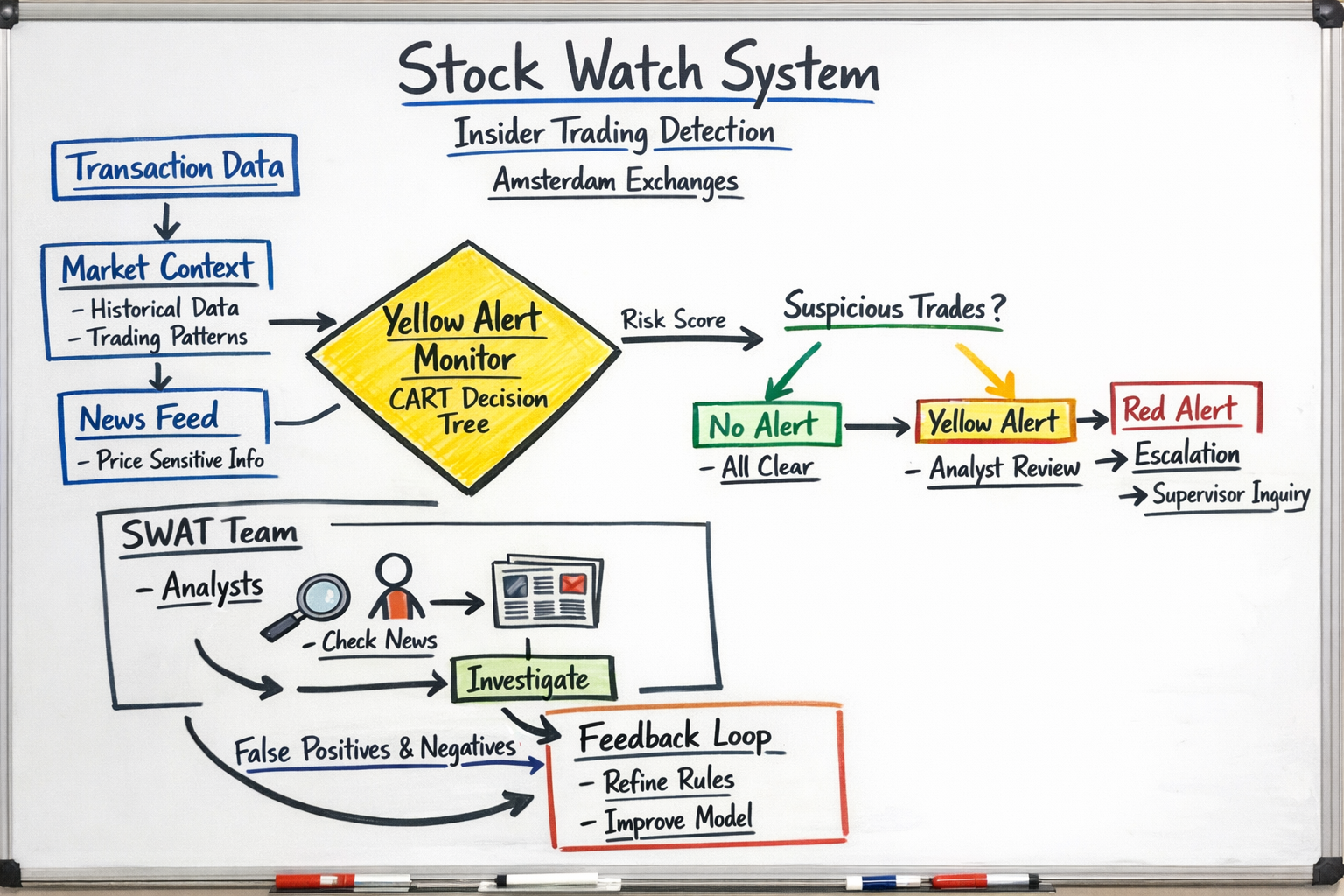
Stock Watch process and data flow.
This case, which started in 1995 and was completed in 1997, showed early on that effective detection is never just about the model, but about combining data, context, explainability, and human judgment. It remained in use for many years because it was embedded in a real operational process with feedback, ownership, and continuous improvement. Nearly 30 years later, that is still the core lesson for data, AI, and governance.
When people talk about AI, machine learning, and intelligent decision support, the discussion often sounds as if these challenges are entirely new. They are not.
A case I worked on for Amsterdam Exchanges, which started in 1995, was developed and completed between 1995 and 1997, and then remained in use for many years, still captures many of the issues organisations face today: too much data, too little context, dependence on a small number of experts, and the need for explainable, operational decision support. The Stock Watch system was designed to improve the detection of suspicious trading activity by combining transaction data, historical market factors, relevant news, and analyst feedback in one working process.
That is precisely why this case remains relevant nearly 30 years later. Not because the technology is unchanged, but because the underlying design principles still are.
This was never just a model
At the time, the challenge was significant. Analysts had to assess very large numbers of transactions, while support tooling was limited and much of the expertise sat in the heads of only a few specialists. As transaction volumes increased, more potentially suspicious trades risked going unanalysed. The answer was not simply automation for its own sake. The answer was to redesign the full process.
Stock Watch used a CART-based decision tree to classify transactions in real time and assign risk factors. It also incorporated relevant price-sensitive news and analyst review to determine whether unusual behaviour could be explained or should be escalated. In other words, it was not just a detection model. It was a broader operational system in which data, context, human expertise, and escalation logic worked together.
That remains one of the most important lessons for organisations today.
Many data and AI initiatives still fail because too much emphasis is placed on the algorithm and too little on the surrounding operating model. A model without context creates noise. A model without ownership is difficult to trust. A model without feedback degrades over time. A model without explainability is difficult to govern. Stock Watch already made that visible.
Why this case still feels current
There are several reasons why this case still feels highly relevant today.
Context matters more than raw data
One of the core insights in the case was that transaction data alone was not enough. Analysts needed broader context to decide whether a transaction was suspicious. Historical price movements, market conditions, trading patterns, and relevant news all had to be brought together before a meaningful risk judgment could be made.
That is still true in modern AI and analytics. Whether the use case is fraud detection, compliance monitoring, customer intelligence, or operational optimisation, raw data is rarely enough. The real value comes from enriched data, connected context, and meaningful interpretation.
Explainability is not optional
The choice for CART was deliberate. The project did not go for a black-box approach. It used a technique that analysts could understand, validate, and refine. That mattered because the output of the system influenced real decisions, real investigations, and potentially legal consequences.
Today, we discuss this under AI governance, responsible AI, and model risk management. But the practical issue is unchanged: if the people using a system cannot understand why it behaves the way it does, trust remains weak and adoption stays limited.
Human-in-the-loop is a strength
The system generated alerts, but those alerts still had to be reviewed by analysts. Analysts checked related news, assessed whether unusual transactions could be explained, and escalated cases when needed. Their judgment was not an afterthought. It was part of the design.
That lesson remains highly relevant. In many modern AI discussions, automation is treated as the goal. In practice, the strongest systems combine machine speed with human judgment. Machines can prioritise and detect patterns at scale. Humans provide interpretation, nuance, accountability, and learning.
Feedback and governance determine quality over time
One of the strongest elements of Stock Watch was the maintenance process. False positives and false negatives were reviewed. Factors were refined. Data sets were improved. Decision trees were tested and updated before being used again. The system was treated as a dynamic capability that required ongoing stewardship.
In today’s language, that is governance in practice.
This is also where many initiatives still fail. Organisations may build a promising model, but often invest too little in lifecycle management: monitoring performance, learning from exceptions, updating logic, improving data quality, and embedding ownership. Over time, quality declines and trust erodes.
Why the timeline matters
The fact that this case started in 1995, was completed in 1997, and then remained in use for many years matters for an important reason: it shows this was not a short-lived experiment or a proof of concept. It became an operational system with lasting value.
That is an important distinction. Many organisations still produce pilots that look impressive but never become durable capabilities. This case shows what it looks like when analytics is embedded in process, supported by people, and maintained over time.
That long production life is one of the strongest signals that the design worked.
Why this also speaks to Vista Veritas
What makes this case so relevant today is that it reflects exactly the type of challenge many organisations still face. The issue is rarely just the model, or just the technology. The real challenge is how to combine data, context, explainability, ownership, and process into something that works reliably in daily practice.
That is precisely where Vista Veritas fits naturally.
Cases like this require more than technical implementation alone. They require clear thinking about data foundations, governance, roles, decision logic, human oversight, and continuous improvement. They also require people in the organisation to understand not only how a solution works, but why it works, where its limitations are, and how to improve it over time.
This is where advisory and training come together. Advisory helps shape the structure around the solution: the governance, the data flows, the operating model, and the responsibilities. Training helps ensure that teams can actually work with that structure in practice, apply it consistently, and build confidence in using it.
In that sense, a case like Stock Watch is a strong example of the kind of environment in which Vista Veritas brings value: situations where organisations want to move beyond ideas and pilots, and build data and AI capabilities that are practical, explainable, and sustainable.
The lesson still stands
If I had to summarise the enduring value of this case in one sentence, it would be this:
Successful AI is not created by models alone, but by combining data, context, explainability, human judgment, and governance into one working system.
That was true when this case began in 1995.
It was true when the solution was completed in 1997.
And it is still true today.
